

The Ultimate Blueprint for Your Online Business Growth
Built on strategy, execution discipline, and measurable systems — so your growth stops depending on luck.
The Hidden Truth Behind Your Business Success
The first thing you need to understand about growing your business is this:
It only works at full force when built on a compound system.
Yet everywhere you look, there’s another “expert” selling a magic shortcut.
Some say
Its all about social media
Others swear SEO is the holy grail
A few insist paid ads are the only path
And of course… the ₹99 workshop that promises to change everything overnight
Here’s the uncomfortable truth:
Most of what you see are fragments — not systems.
Single tactics dressed up as complete solutions.
Isolated strategies sold as guaranteed breakthroughs.
Noise packaged as opportunity.
And it works — because shouting is easier than building.
Because selling hype is faster than building structure.
Because fragments are simpler to market than full frameworks.
But real business growth doesn’t happen in fragments.
It happens when:
-
Positioning aligns with messaging.
-
Messaging aligns with traffic.
-
Traffic aligns with conversion.
-
Conversion aligns with retention.
-
And everything feeds into a measurable system.
That’s what compound growth actually means.
It’s not about choosing one channel.
It’s about orchestrating multiple moving parts into one controlled engine.
Anything less is just activity.
Not scale.
The Reality Big Brands Know (But Rarely Talk About) 🤫
Ever wondered how big brands rise — and more importantly — stay at the top?
It isn’t luck.
It isn’t one lucky campaign.
And it definitely isn’t one marketing channel.
It’s compound execution.
These companies don’t bet everything on a single tactic.
They build ecosystems.
Brand positioning feeds content.
Content feeds traffic.
Traffic feeds conversion.
Conversion feeds retention.
Retention fuels scale.
Now you might be thinking:
“Of course they can do that. They have millions to spend.”
Yes — budget helps.
But budget without structure only burns faster.
What actually separates them isn’t just money.
It’s orchestration.
It’s alignment.
It’s teams executing a unified strategy instead of random tactics.
Take Dollar Shave Club as an example.

When they entered the men’s grooming industry, they were up against giants like Gillette.
They didn’t outspend them.
They out-positioned them.
A bold brand voice.
A viral launch video.
Smart subscription economics.
Targeted paid ads amplifying attention.
It wasn’t one move.
It was coordinated pressure from multiple angles.
That’s compound growth in action.
Ask yourself:
Do you think brands like this could compete with industry giants if they relied on just one marketing method?
Of course not.
And here’s the uncomfortable part —
If you’re building a business expecting one tactic, one post, one ad campaign, or one workshop to magically carry everything…
You’re not building a business.
You’re gambling.
Real growth requires effort.
But more importantly — it requires structure.
Effort without a system is noise.
Effort inside a system becomes growth.

The Disruption in the Entrepreneurial Ecosystem
Entrepreneurship is thriving.
More founders.
More creators.
More dreamers building something of their own.
That’s powerful.
But where there is ambition… there is exploitation.
Some individuals have built entire business models around selling shortcuts to hungry entrepreneurs.
Overnight success.
One-tactic domination.
“Just do this and you’ll scale.”
It sounds simple.
It feels comforting.
But it’s rarely complete.
The real manipulation isn’t in what they say.
It’s in what they leave out.
They convince you that marketing is simple.
That growth is linear.
That one tool, one platform, one course can replace structure.
But growth is not one-size-fits-all.
It’s multi-layered.
It’s interconnected.
It’s compound.
So how does this trap work?
Not because you’re naive.
Not because you lack intelligence.
You’re an entrepreneur.
You’ve sacrificed time.
Capital.
Comfort.
Certainty.
So you can’t be fooled by them.
But the reason you still get tricked by these scumbags is far darker than you think.
They target your fear.
-
Feeling overwhelmed by too many moving parts?
They offer “just focus on one thing.” -
Concerned about investment budgets in branding or marketing?
They promise “cheap and fast.” -
Unsure how to build a capable team?
They sell DIY shortcuts disguised as empowerment.
It feels like relief.
But relief is not the same as leverage.
Real leverage comes from structure.
There’s a quote often misused:
“A jack of all trades is a master of none.”
But the full version reads:
“A jack of all trades is a master of none, but oftentimes better than a master of one.”
Versatility — when structured — becomes strength.
The edge isn’t mastering one tactic.
The edge is understanding how multiple parts work together.
That’s the compound approach.
And when executed correctly…
It changes everything.
Now it’s time for you to wake up.
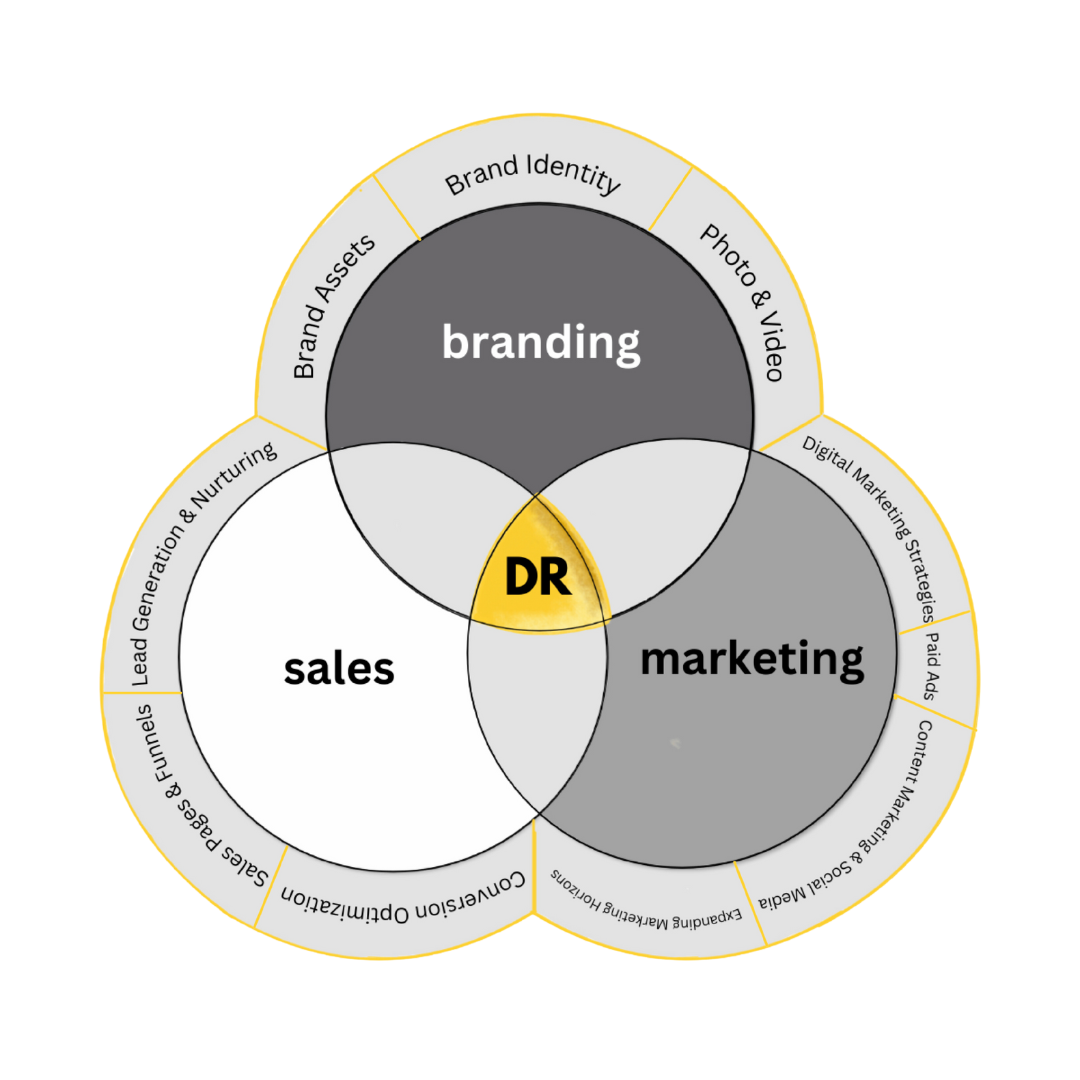
The Golden Trinity Circle of Business Success
Phase 1
BRANDING
Your brand is your business’s core identity.
It defines why you do what you do — and shapes how your audience feels, trusts, and remembers you.
1. brand assets
Brand assets are all the materials that visually and physically communicate your brand. These can range from business cards to billboards, ensuring that your message remains clear and consistent across every touchpoint. These assets help **reinforce your brand’s presence** wherever they appear.
2. brand identity
A strong brand identity goes beyond just a logo. It encompasses the colors, tone, messaging, and values that represent your business. By crafting an identity that resonates with your ideal customer, you can build **trust** and **recognition** with every interaction.
3. photos & videos
Creating an authentic connection with your audience is key. Instead of relying on stock images, consider using high-quality, original photography and video content that reflects your brand’s unique personality. This helps to humanize your business and build stronger connections with potential customers.
Phase 2
MARKETING
Your brand gives you identity.
Marketing gives you visibility.
Once your brand is established, marketing ensures it reaches the right audience — not just to attract attention, but to convert curiosity into interest.
4. digital marketing strategies
Successful marketing strategies go beyond just visibility; they focus on targeting the right audience and guiding them through their journey. By understanding your audience’s pain points and crafting tailored campaigns, you can ensure that your brand message reaches those who are most likely to engage and convert.
5. paid ADS
Pay-per-click campaigns on platforms like Google, Facebook, or Instagram can be powerful tools for driving traffic to your website. These ads target specific audiences to deliver the right message at the right time, increasing the chances of turning visitors into leads and customers.
6. content marketing & social media
Marketing doesn’t stop at ads. A well-executed content marketing strategy is essential for keeping your audience engaged. Regular blog posts, newsletters, and social media updates that provide valuable insights help build trust and establish you as an expert in your field.
7. expanding marketing horizons
Marketing is never static. As your business grows, it’s important to expand your marketing reach by exploring new strategies. This can involve testing emerging platforms, using automation, or delving into influencer partnerships. Continuous evolution in marketing ensures that your brand stays **ahead of trends** and **reaches new audiences**, keeping your business at the forefront of its industry.
Phase 3
SALES
Sales is where attention becomes commitment.
It transforms curiosity into customers — and strategy into revenue.
8. lead generation & nurturing
Generating leads is only the first step. It’s crucial to nurture them by providing relevant content, personalized experiences, and consistent follow-ups. Building these relationships over time leads to higher conversion rates and a more predictable sales cycle.
9. sales pages & funnels
A well-designed sales funnel helps guide potential customers from interest to action. By creating high-converting sales pages and clear calls-to-action, businesses can simplify the buying process for customers, making it easier for them to make decisions, ultimately driving **revenue growth**.
10. conversion optimization
The final phase is focused on optimizing every touchpoint to maximize conversions. Whether through A/B testing, adjusting product pages, or offering compelling promotions, refining your process leads to higher sales. Additionally, having **Standard Operating Procedures (SOPs)** in place for repetitive tasks ensures efficiency and consistency, freeing up time to focus on growing the business and enhancing your teams experiences.
Understand why The golden trinity circle is so important!!!
In today’s fast-paced, highly competitive digital landscape, businesses can’t afford to rely on a single strategy or hope that one marketing channel will do all the work. This is where the Golden Trinity Circle and the Compound Effect come into play—they aren’t just strategies; they’re the blueprint for sustainable growth and success. Let’s break down why they’re so crucial:
1
Diversifying Your Traffic Sources
Imagine relying on just one stream of traffic—say, just social media or paid ads. What happens if the algorithm changes, or your ad budget runs dry? Your traffic—and ultimately your revenue—can disappear overnight. The Golden Trinity Circle model prevents that by diversifying where your traffic comes from.
By utilizing multiple channels—social media, organic search, email marketing, paid ads, and more—you create multiple entry points for potential customers.
More traffic means more eyes on your brand, and when your sales process is optimized, more traffic directly translates into higher revenue. But remember, the key isn’t just driving random traffic—it’s about creating strategic campaigns across various channels that resonate with the right audience, at the right time, in the right place.
2
Understanding the Customer’s Journey: From Interest to Action
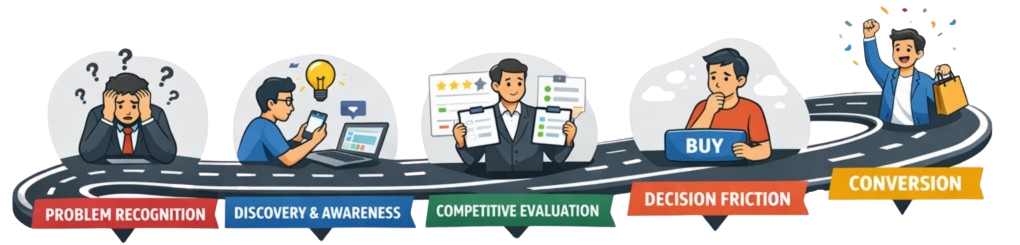
When it comes to making a purchase, customers don’t just wake up and buy. They go through a journey—a journey that, if you understand and nurture properly, can lead them right to you. Here’s how that journey looks:
- Problem Recognition Stage
It starts with a need or problem. A customer realizes they want or need something—whether it’s a product, service, or solution. - Discovery & Awareness Stage
The first thing they do? They go online, start researching, and often compare multiple options. This is where your digital presence (branding, SEO, ads, and content) is crucial. If they can’t find you or you don’t make a memorable impression, you’re already out of the race. - Competitive Evaluation Stage
At this stage, your potential customer is actively comparing options. They’re seeing your competitors’ ads, browsing their websites, reading reviews, and weighing alternatives. This is where your branding has to do more than just look good — it has to create clarity and confidence. Your positioning, storytelling, visuals, and messaging must work together to show that you understand their problem better than anyone else. When your brand feels consistent, professional, and relatable, trust begins to form — and in a crowded market, trust is what tips the decision in your favor.
- Decision Friction Stage
By now, the customer is overwhelmed. Too many options, too many promises, too little time. This is where most brands lose them. If everything sounds the same, they default to what feels safest or simplest. Your job here is to remove friction. Clear messaging, strong authority signals, transparent information, and structured guidance help them feel confident instead of confused. When your brand becomes the one that simplifies the decision instead of complicating it, you naturally move ahead of the noise. - Conversion Stage
Now it comes down to execution. It’s no longer about awareness or branding — it’s about experience. Is your process smooth? Is communication clear? Is the next step obvious? Even a highly interested buyer can drop off if the buying journey feels clunky or uncertain. This is where strong systems matter — intuitive design, interactive elements, responsive communication, and a seamless checkout or onboarding flow. When everything feels effortless and valuable, interest turns into action — and action turns into revenue.
If you miss even one of these stages—whether it’s your branding, marketing, or sales process—customers are more likely to bounce back, opting for someone else who fulfills all their needs. It’s not about having the best of one thing—it’s about having every piece working together
Power of The golden circle
BRANDING
gives you the “why”—it establishes your purpose and creates emotional connections with your audience.
MARKETING
expands your reach, ensuring your brand message is seen by the right people at the right time.
SALES
transforms awareness into action, converting leads into customers and generating revenue.
ready to build your golden circle?
This isn’t just about completing a checklist—it’s about building a **strategic system** that unites all the essential elements for business growth. From branding to sales optimization, each phase of the blueprint works together to drive success.